Breakthrough Meeting: First Quantified Business Model
246h → 65h
Project hours reduction
73%
Less delivery effort
13w → 7w
Timeline compression
$43K
Same price, 3x+ margin
4.6
Overall Average
3.3 → 4.6
vs Last Meeting
7
Highest Score
2
Lowest Score
7+
Participants
+1.3
Avg Gain
Score Trend Across All Meetings
Adopt
KB
Wflow
UAT
Roles
Biz
PM
Agent
Accel
Avg
Apr 21
4
3
4
2
3
1
3
1
5
3.1
Apr 28 sync
4
3
4
4
3
1
3
1
5
3.3
Apr 28 full
5
4
5
5
5
4
3
2
7
4.6
Delta
+1
+1
+1
+1
+2
+3
--
+1
+2
+1.3
Speaking Time by Participant
Mohammad Alazzouni
~25 min
Max Votek
~13 min
Maxim Solovyov
~8 min
Taras Khudoba
~6 min
Kevin
~3 min
Max Shevchenko
~2 min
Conversation Timeline
Mohammad
Max Votek
Maxim Solovyov
Taras Khudoba
Kevin
Max Shevchenko
0:0010:0020:0030:0040:0050:0057:00
Participants
Mohammad Alazzouni (delivery lead, presenter)
Max Votek (strategy, AI training)
Maxim Solovyov (partnerships, ops)
Taras Khudoba (facilitator)
Kevin (estimator, SPIFF platform)
Max Shevchenko (SPIFF config)
Andrey & Denis (AI global coordination, observers)
Slides Presented (Mohammad Alazzouni)
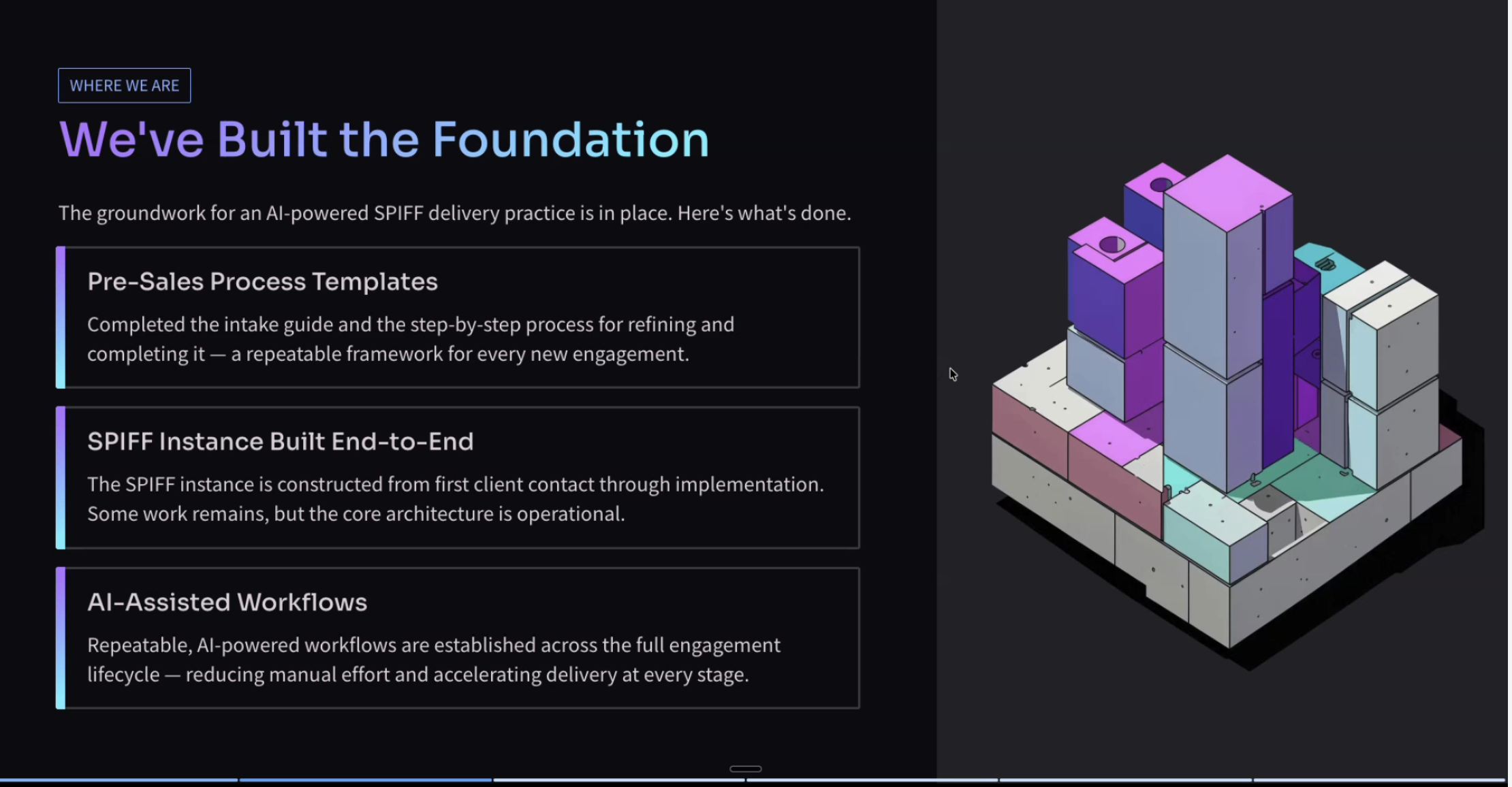
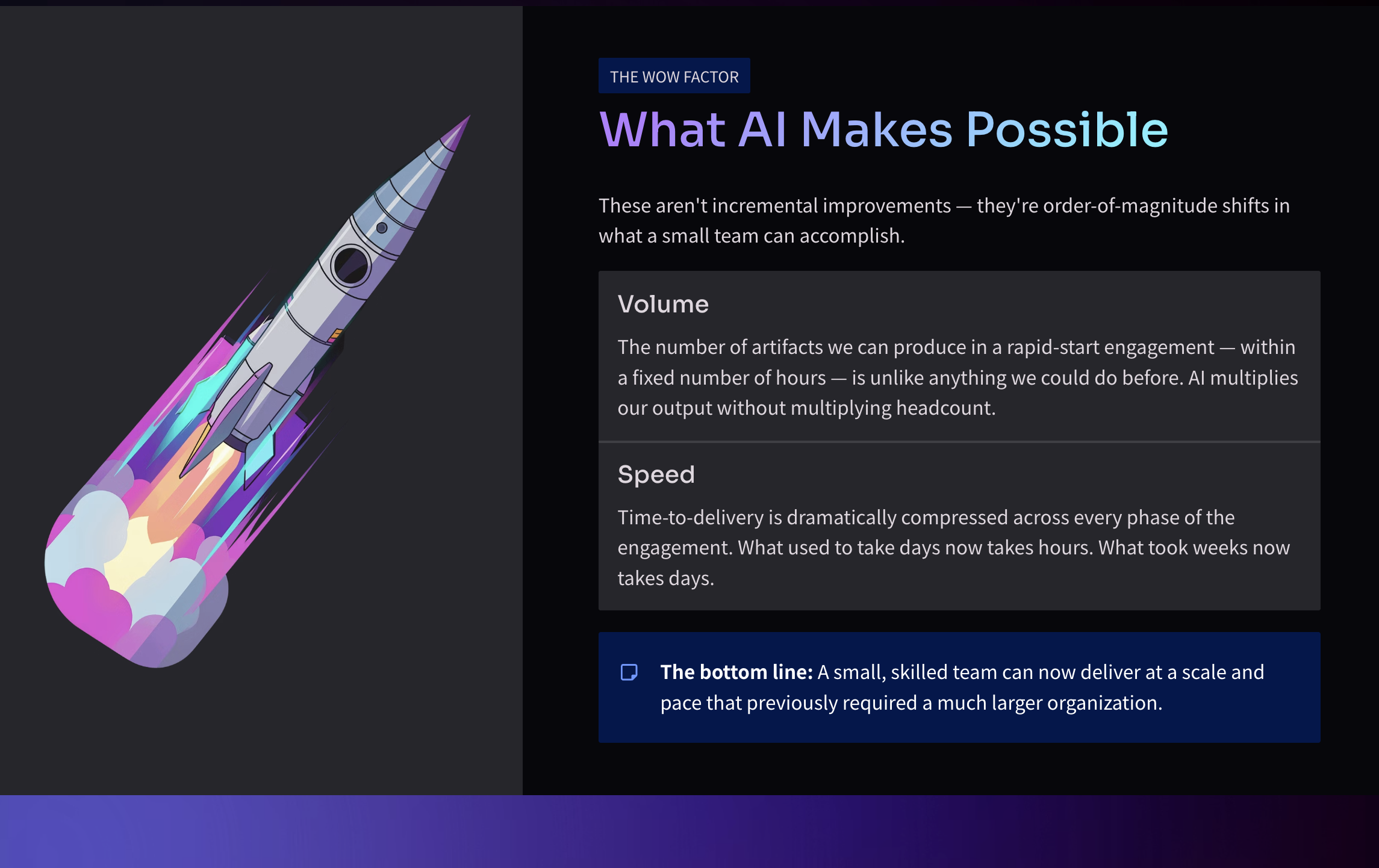
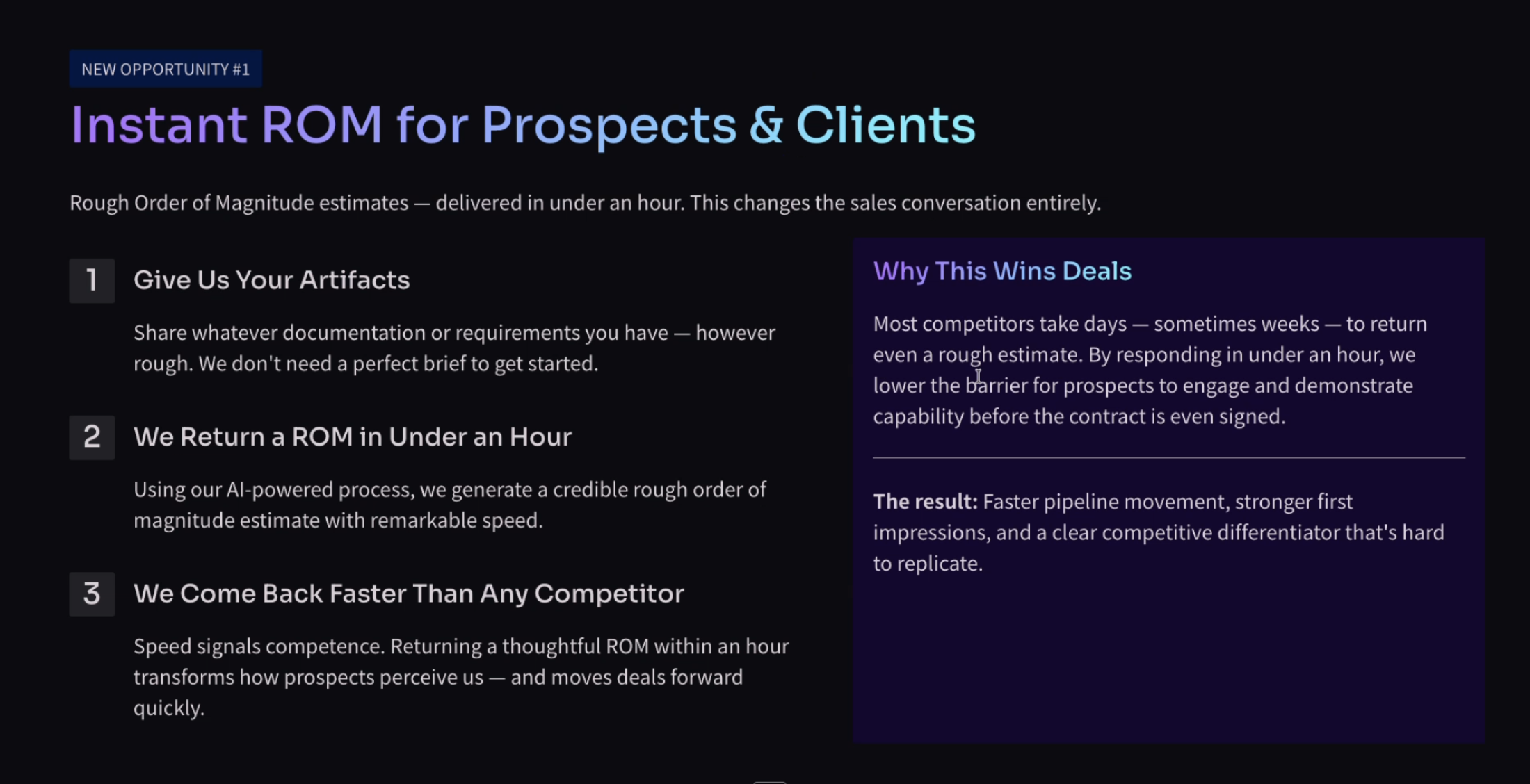
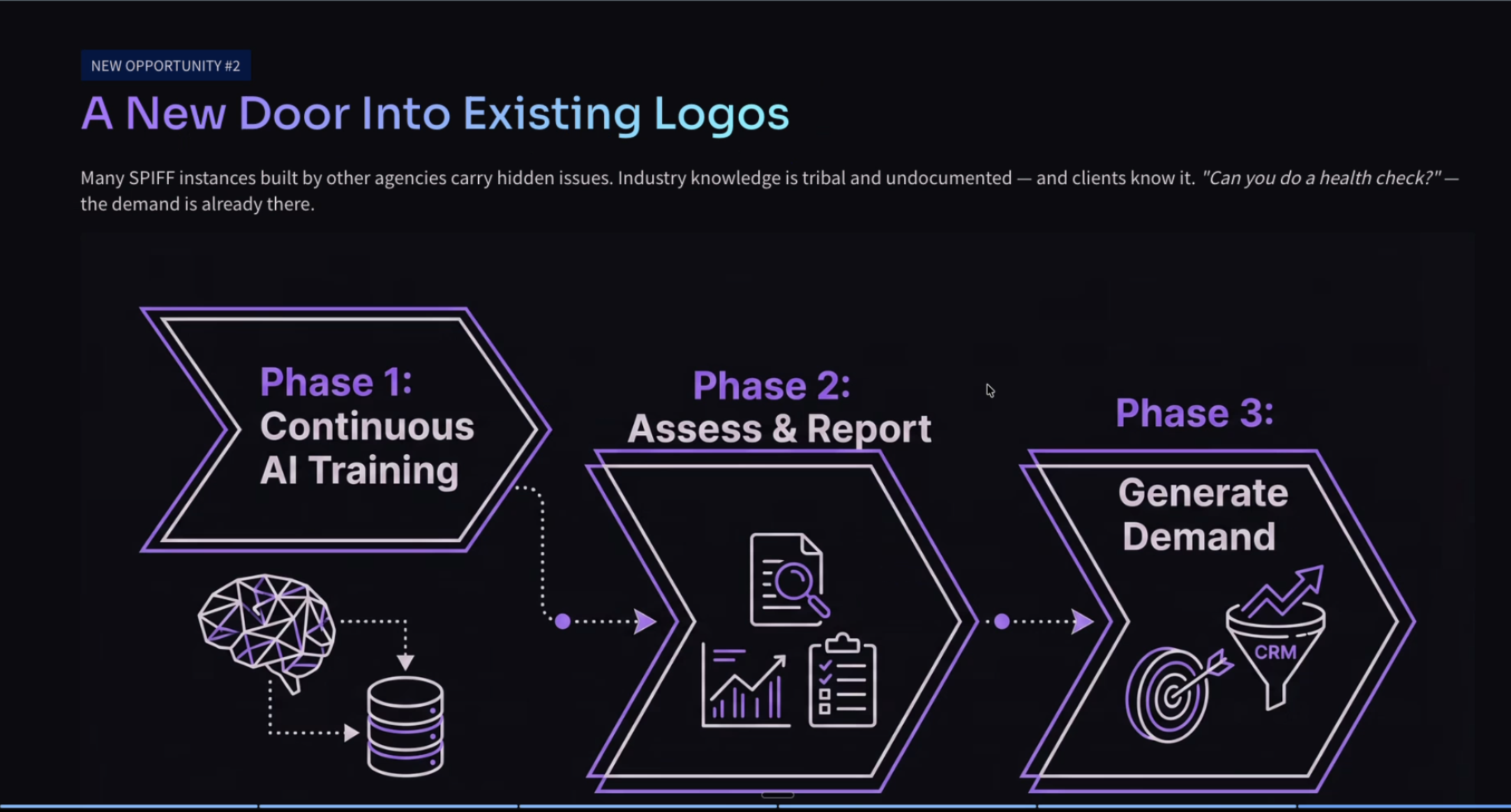
Key Takeaways
- Build review: SPIFF config works but is a "black box" — calculations done somewhere unknown, worksheets empty. Fields not in expected objects. Needs training on how to build, not just what to build.
- First quantified model: 246h traditional → 65h with AI (73% reduction). 13 weeks → 7 weeks. Developer role eliminated. Project price stays at ~$43K but margins 3x+ higher.
- Three accelerators for Salesforce: (1) ROM estimator in under 1 hour, (2) AI-powered health check for existing clients, (3) Rapid start with more output per hour. Presenting to Salesforce Monday.
- Estimator active: Kevin demoed expanded pre-sales estimator with individual plan tabs, integration section, complexity matrix. Target: complete by end of week.
- Team training session planned: Max Votek + Max Shevchenko to train Mohammad, Kevin, Valeria together on Claude Code fundamentals — CLI, Playwright, calculation schemas.
- Anthropic partnership: Claude Code certification program available. Arkhip Koloskin completed in 4 hours. All team members expected to certify.
- Video generation: Max Votek + Maksim Shcherbak developed approaches for automated training/demo videos with personal avatars via Claude Code.
- Health check concept: Leverage tribal SPIFF knowledge to assess existing instances. Two AEs already requesting. Opens door to managed services and upsell.
- Website concept: Quick start vs. custom decision tree, client form, success stories by industry, automated AE booking. Solovyov suggested converting estimator to Shiny app.
- Andrey & Denis joined: Taking over global AI coordination — expanding visibility of this initiative company-wide.
Workstream Assessment
1. Team Adoption +1
People actively using AI tools
5/10
Structured team training planned. Certification program activated. Valeria onboarded to Claude Code.
Valeria learned Claude Code "yesterday" — first hands-on session. Team training session planned with Max Votek + Max Shevchenko for Mohammad, Kevin, and Valeria simultaneously. Anthropic certification program available; Arkhip Koloskin completed in 4 hours. All team members expected to certify. Andrey and Denis joining expands company-wide visibility.
"Valeria only learned how to use Claude Code yesterday" — Mohammad
"Maybe it would be great for Valeria, me and Kevin to all learn at the same time" — Mohammad
"Arkhip Koloskin he's a champion. I assigned him yesterday, and today he came up with 'I am first one, I am done'" — Maxim Solovyov
"Maybe it would be great for Valeria, me and Kevin to all learn at the same time" — Mohammad
"Arkhip Koloskin he's a champion. I assigned him yesterday, and today he came up with 'I am first one, I am done'" — Maxim Solovyov
2. Knowledge Base +1
MD files, GitHub repo, reuse
4/10
Max Shevchenko published learnings to GitHub. Communication gap driving knowledge capture urgency.
Max Votek noted Max Shevchenko "shared a pretty good result with the summary of learnings... several approaches which can be reused for the next customizing sessions." Need for project-specific GitHub with progress/issues/knowledge identified. Sessions to be recorded for quick-start knowledge. Training the AI on how to build (not just what) is itself a knowledge capture exercise.
"Max shared a pretty good result with the summary of learnings after the customizing session... several approaches which can be reused" — Max Votek
"We need a project-specific GitHub with all the knowledge and the progress and the issues" — Max Votek
"We need a project-specific GitHub with all the knowledge and the progress and the issues" — Max Votek
3. AI Workflows +1
Doc, config, test, implementation
5/10
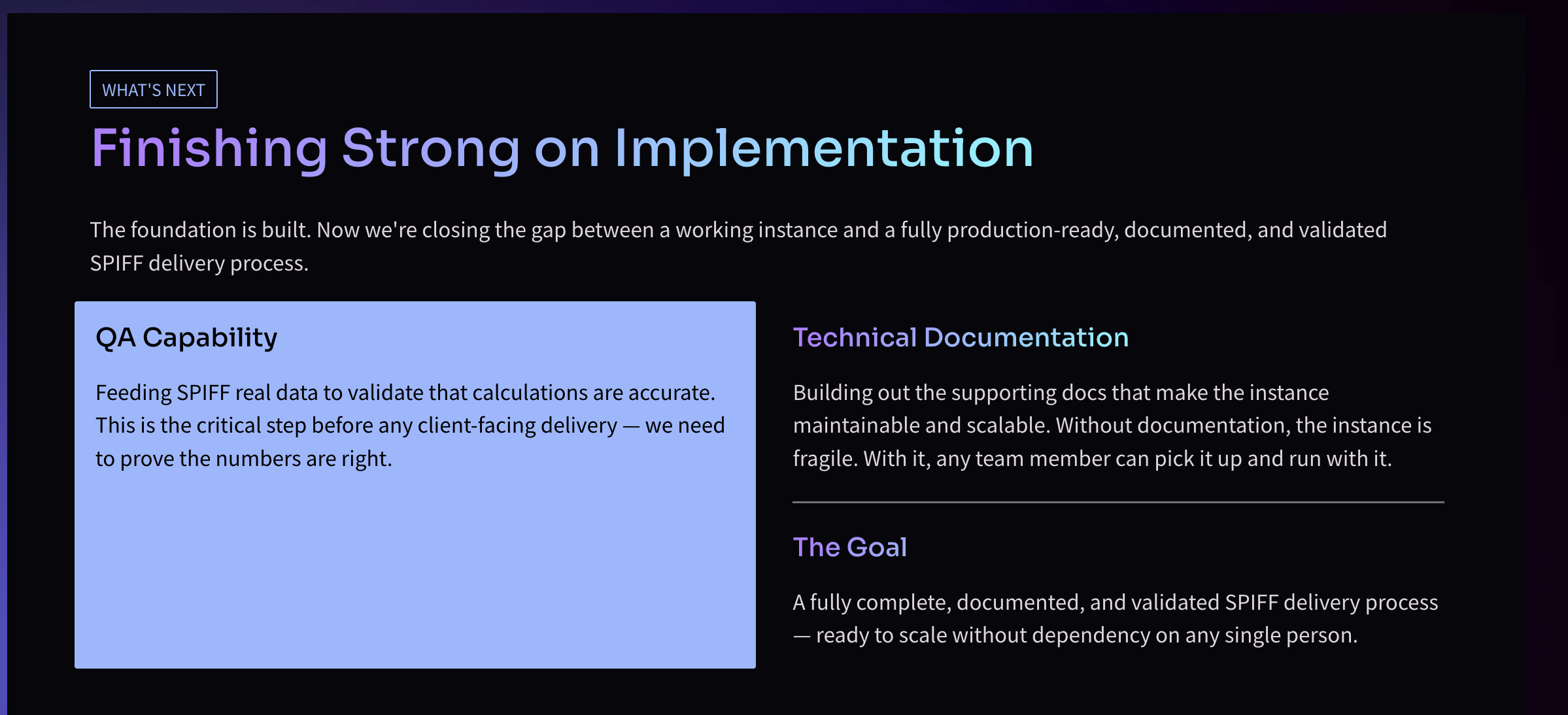
Config workflow produces results but needs "how to build" training. QA and tech docs identified as next workflows.
Build works but output is unreadable — needs teaching on proper worksheet population. Pre-sales estimator workflow actively being built (Kevin). Technical documentation workflow identified as critical client need. QA agent concept on roadmap. Video generation workflow explored. The gap is clear: AI can build, but must be trained to build in a human-readable, auditable way.
"It built it, but we're not sure how or where... we need to train it to fill this the way we would look at a current example" — Mohammad
"A current client really needs technical documentation right now... it was going to take one of our consultants a lot of hours" — Mohammad
"A current client really needs technical documentation right now... it was going to take one of our consultants a lot of hours" — Mohammad
4. UAT & Refinement +1
Feedback loop compression
5/10
Valeria reviewed the build and found concrete gaps. UAT is actively happening, surfacing real issues.
Worksheets empty (black box build). Fields not in expected objects. Calculations "seem accurate" but need full quarter comparison. Joint review session planned with Max Shevchenko + Valeria + Kevin. The fact that they're finding specific, actionable gaps means UAT is working — even though the build needs refinement. "Nothing is a showstopper."
"She sees calculations are being made... but the worksheet is not built. It's kind of like a black box the way it was built" — Mohammad
"Nothing that's a showstopper because things can be built, but we need to continue to refine it" — Mohammad
"Nothing that's a showstopper because things can be built, but we need to continue to refine it" — Mohammad
5. Role Compression +2
Fewer roles, broader coverage
5/10
First quantified staffing model: 3 roles → 2, developer eliminated, 73% hours reduction.
Traditional: Solution Lead (76h) + Functional Consultant (144h) + PM (26h) = 246h. AI model: Architect (54h) + Developer (0h) + PM (11h) = 65h. Functional consultant role absorbed entirely. Developer role eliminated. This is the first concrete, numbers-backed proof of role compression. The slide confirms: "A small, skilled team can now deliver at a scale and pace that previously required a much larger organization."
"Sixty five hours rather than two hundred and sixty hours... the developer will be taking zero hours" — Mohammad
"The bottom line: A small, skilled team can now deliver at a scale and pace that previously required a much larger organization" — Slide
"The bottom line: A small, skilled team can now deliver at a scale and pace that previously required a much larger organization" — Slide
6. Business Model +3
Fixed-price / outcome-based shift
4/10
Biggest mover: from vision-only to a concrete pricing model with margins quantified.
Project price stays at ~$43K but internal cost drops from 246h to 65h at $175/hr = ~$11K internal cost vs ~$43K revenue. "Ideally we don't bill per hour... if it's going to be a fixed project... the margins will be a lot higher." Quick start vs custom decision tree discussed. Front-loading solution design (3 weeks) to eliminate mid-project surprises. Presenting to Salesforce on Monday.
"The project itself might still be $43K... but the margins will be a lot higher this way" — Mohammad
"Ideally we don't bill per hour, or if it's going to be kind of like a fixed project" — Mohammad
"Ideally we don't bill per hour, or if it's going to be kind of like a fixed project" — Mohammad
7. PM & Tracking = 0
Profitability, plan vs actual, forecast
3/10
No new PM tooling or process. Estimator is pre-sales, not PM.
The staffing model comparison is useful for planning but isn't a PM system. Still cannot answer: profitability by project, planned vs actual hours, or forecasting accuracy. Taras structured next steps well but no tracking system discussed.
8. Agent Architecture +1
Specialized agent experiments
2/10
First concrete agent concepts: QA agent and pre-sales → delivery agent handoff.
Mohammad discussed a QA agent to validate calculations. Also described pre-sales agent feeding into delivery agent via intake guide. Still conceptual — no agent built or tested. But these are the first specific agent roles articulated in a meeting.
"How can there be a QA agent to ensure that all the data is correct within the SPIFF build?" — Mohammad
"The pre-sales agent would talk to the delivery agent, and then the intake guide can be filled with the artifacts" — Mohammad
"The pre-sales agent would talk to the delivery agent, and then the intake guide can be filled with the artifacts" — Mohammad
9. Accelerators +2
Packaged products (e.g. territory mgmt)
7/10
Three packaged accelerators taking shape. Estimator near completion. Presenting to Salesforce Monday.
(1) ROM Estimator: Kevin demoed working version with individual plan tabs, complexity matrix, integration section. Complete by end of week. (2) Health Check: AI assessment of existing SPIFF instances. Two AEs already requesting. Three-phase roadmap: train AI → assess → generate demand. (3) Automated Videos: Training/demo videos via Claude Code with personal avatars. Website concept with industry-specific success stories and AE booking flow. Professional slides already packaged.
"My expectation for this to be completed by end of this week, so that I can present to Salesforce" — Mohammad on estimator
"Can we do a health check? Two AEs... said they would like some health check" — Mohammad
"We developed approaches with Maksim Shcherbak, how to make videos fully automated by Claude Code" — Max Votek
"Can we do a health check? Two AEs... said they would like some health check" — Mohammad
"We developed approaches with Maksim Shcherbak, how to make videos fully automated by Claude Code" — Max Votek
Blockers & Risks
SPIFF build is a "black box" — calculations in unknown locations, worksheets empty. Needs retraining approach.
BLOCKING
Communication gap between builder (Max Shevchenko) and validator (Valeria) — not using same Claude session or shared context.
AT RISK
Team learning fragmented — everyone using Claude Code differently. Need unified approach.
AT RISK
Calculation accuracy unconfirmed — "seems accurate" is not validated. Need full quarter comparison.
WATCH
Should estimator be given to Salesforce AEs directly, or kept as reason to engage? Strategic decision needed.
WATCH
Action Items
Joint session: Max Shevchenko + Valeria + Kevin — review build gaps, identify where calculations live
Mohammad / Max S.
Team training session on Claude Code fundamentals (CLI, Playwright, schemas, knowledge workflows)
Max Votek + Max S.
Complete pre-sales estimator Excel — all formulas, integration section, complexity matrix
Kevin
Present ROM estimator + health check roadmap to Salesforce AE team
Mohammad (Monday)
Valeria: get full quarter of commission data for calculation accuracy validation
Valeria / Mohammad
Share Claude Code certification link with team
Maxim Solovyov
All team members: complete Claude Code certification (Anthropic partnership requirement)
All
Record all training/review sessions for quick-start knowledge base
Max Shevchenko
Explore converting estimator spreadsheet to web app (Shiny or Claude Code built)
Maxim Solovyov
Train AI on proper SPIFF build approach — use existing well-built project as reference
Mohammad / Max S.
Generated from meeting transcript + slides — SPIFF/SPM AI Configuration Project